The short version, in seven cards
One MP in Uttar Pradesh speaks for 30 lakh people. One in Tamil Nadu, 18 lakh. The bill that would have closed that gap lost by 54 votes.
24 Apr 2026 · 5 min read · 10 sourcesUttar Pradesh, per Lok Sabha seat
30 lakhpeople per MP
Seats were frozen fifty years ago. Populations were not, so the gap kept growing.
about 1.7 times the people behind one Tamil Nadu seat, which is 18 lakh 12 lakh more people per MP
one Uttar Pradesh vote worth about six-tenths of a Tamil Nadu vote 18 lakh divided by 30 lakh
One MP in Uttar Pradesh speaks for about 30 lakh people. One in Tamil Nadu speaks for 18 lakh. Same job, same single seat, 12 lakh more people behind it.
Source · PRS Legislative Research · Vaishnav & Hintson, Carnegie Endowment
What most people think
It was the women's reservation bill: one in three seats kept for women. The opposition blocked it.
What the data shows
543 → 850seats
You heard it as the women's reservation bill. The same bill also raised the Lok Sabha ceiling to 850 seats and opened every constituency boundary to a redraw by population.
Source · PRS Legislative Research, 131st Amendment Bill brief
The seat map was frozen in 1976 and has not moved since. The 2023 women's law even switched itself off until a new census and a new map arrived.
Source · PRS India and Lok Sabha records
Projected seat change · 543-seat scenario
North 174 → 205
If seats followed population, Uttar Pradesh gains 11 and Bihar 10. Tamil Nadu, Kerala and Andhra Pradesh lose 8 each. The change column is the whole fight.
Source · Vaishnav & Hintson, Carnegie Endowment for International Peace, 2019
Constitution (131st Amendment) Bill · Division vote
352 needed
54 short
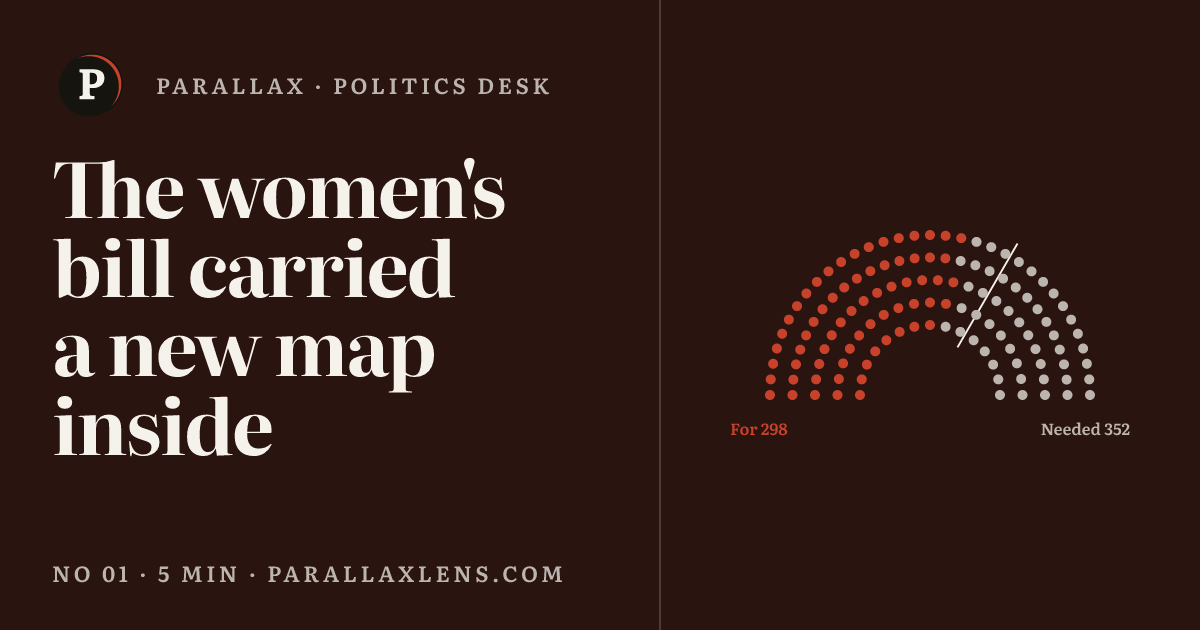
298 voted for it and 230 against. Two-thirds of the 528 in the chamber meant 352. It fell 54 short, and the fifty-year freeze holds.
Source · Lok Sabha division records via SCC Online and PRS India