The short version, in eight cards
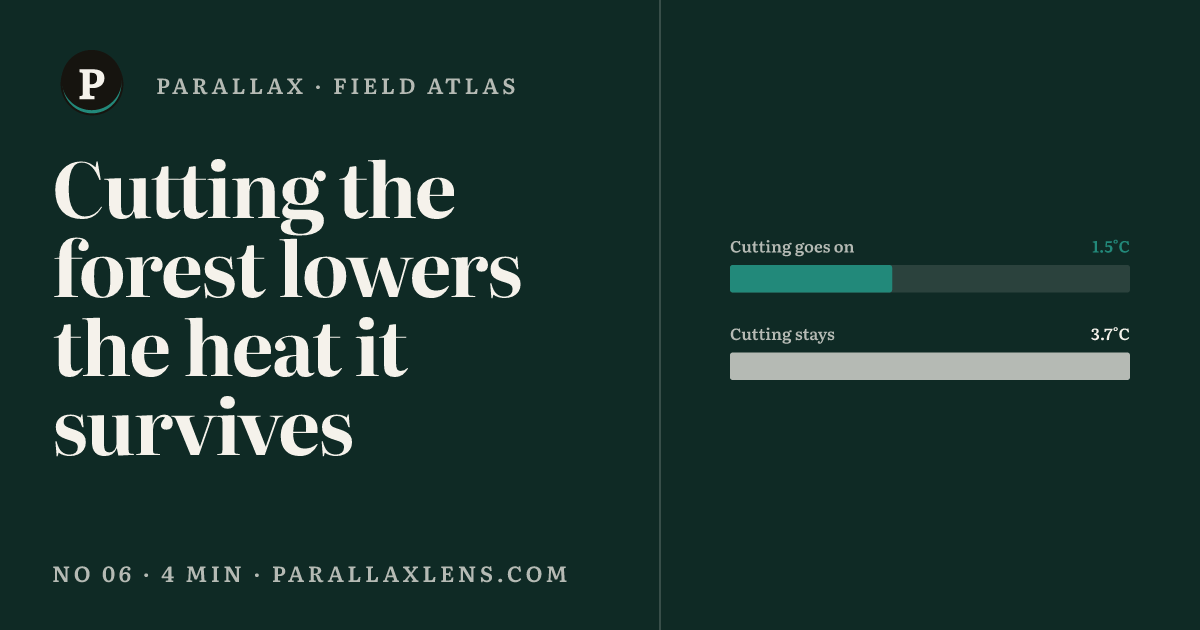
You have been told to watch 1.5°C. Leave this forest alone and it survives 4°C. Keep cutting and 1.5°C is enough.
4 Jun 2026 · 4 min read · 8 sourcesWhat most people think
Keep the world under 1.5°C and the Amazon is safe. That is the deal.
What the data shows
3.7–4°C
What heat alone does
Source · Mongabay and Carbon Brief · 7–8 May 2026
The panel above was the slow dial. Here it stands beside the fast one. Add the cutting and two-thirds to three-quarters of the basin could turn to savanna: dry grass and scattered trees.
Source · Wunderling et al., Nature, as reported by Mongabay and Carbon Brief · May 2026
Step 1
Trees pull water up
Roots draw water from the soil and the leaves breathe it into the air above the canopy.
Step 2
The air drops it again
That moisture drifts inland and falls again. In parts of the basin more than 50% of the rain is made this way.
Step 3
Cut here, kill there
Clear a patch and the air downwind dries, so drought stress can kill trees hundreds of kilometres away that nobody touched.
The Amazon's rain starts the way the monsoon does, and you already know that first half. Wet air comes off the sea and moves inland. But in the Amazon the forest itself keeps that air wet.
Source · Mongabay and Carbon Brief
17%
of the forest cleared
So every patch cleared takes rain with it. Here is where the cutting stands, against the tipping point: the state past which the forest cannot recover on its own.
Source · Mongabay and Carbon Brief · May 2026
So the gap is four to five per cent of the forest. The dates below show how the science found the line, and how the cutting moved.
Source · Mongabay and Carbon Brief reporting
Cleared in the Brazilian Amazon, 2025
5,796km²
That was an 11% fall from the year before.
Nearly four times the area of Delhi Delhi is about 1,480 km².
This is what the good year still cost, measured against a city you know.
Source · INPE PRODES, via Mongabay